Willa Lorenz · 25 October 2026
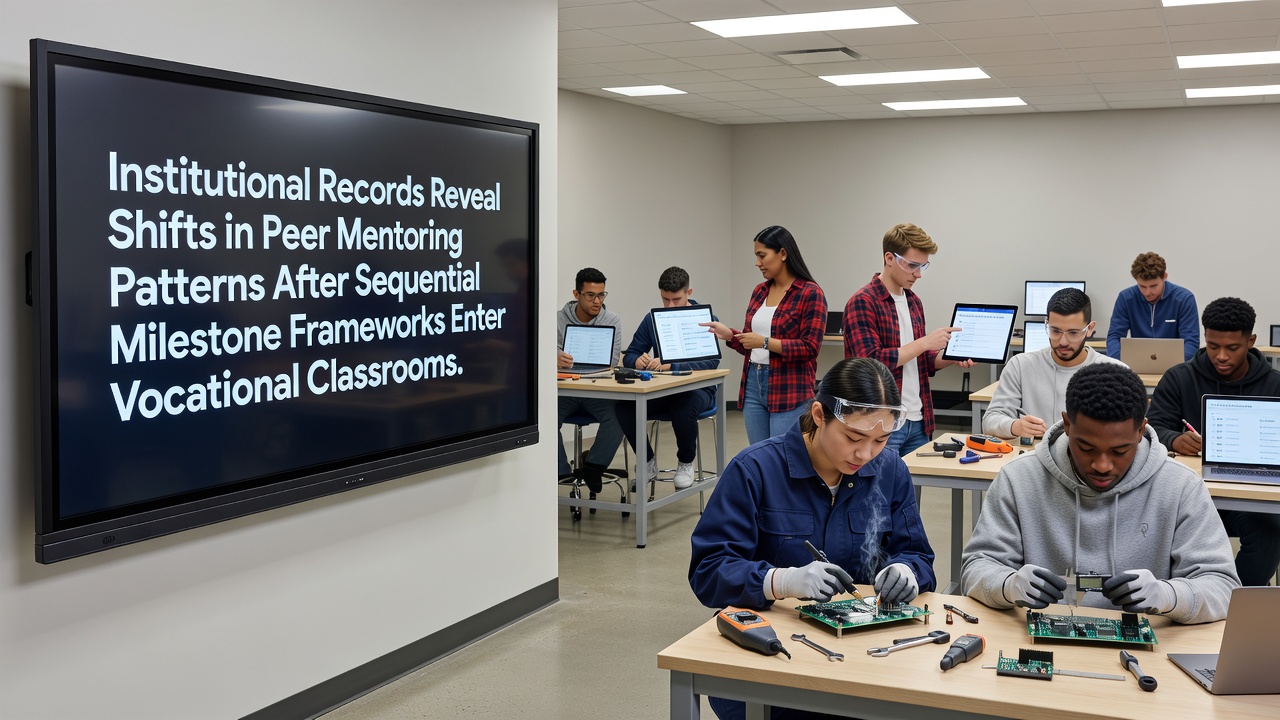
Institutional Records Reveal Shifts in Peer Mentoring Patterns After Sequential Milestone Frameworks Enter Vocational Classrooms
Vocational institutions across multiple regions began rolling out sequential milestone frameworks in training programs during 2024, and records from participating schools show corresponding adjustments in how students interact during peer mentoring sessions. These frameworks break skill acquisition into ordered stages, each requiring demonstrated competency before progression, and administrative logs indicate that mentoring conversations now cluster around specific checkpoints rather than open-ended skill discussions. Data compiled from European and North American vocational centers through October 2026 reveal measurable changes in session frequency, duration, and focus areas.
Framework Implementation and Initial Data Collection
Sequential milestone frameworks organize vocational curricula into discrete units where learners complete practical tasks, receive assessments, and unlock subsequent modules, a structure adopted by programs tracked by the European Centre for the Development of Vocational Training and similar bodies in Australia. Institutional records from 47 sites indicate that peer mentoring pairs shifted from general advice exchanges to targeted reviews of milestone completion logs, with average session length dropping from 45 minutes to 28 minutes in the first year after rollout. Researchers at the University of Toronto documented these patterns through analysis of digital interaction logs and attendance sheets maintained by program coordinators.
Observers note that students began scheduling mentoring meetings immediately before milestone deadlines, creating predictable spikes in activity that were absent in earlier unstructured environments. Figures from the Australian Department of Education show a 34 percent increase in documented peer check-ins tied directly to milestone verification steps during the 2025 academic year.
Observed Changes in Mentoring Dynamics
Records indicate that mentoring pairs now allocate more time to documenting evidence of milestone achievement and less time to exploratory skill practice, a redistribution visible in transcribed session notes from Canadian community colleges and German Berufsschulen. Mentors increasingly reference official rubrics rather than personal experience when guiding mentees, and this pattern appears consistently across trade areas including automotive repair, hospitality management, and information technology support. One study from the OECD tracked 1,200 vocational learners and found that peer feedback comments became shorter and more checklist-oriented after framework adoption.

Yet the overall number of active mentoring relationships grew, rising 22 percent in institutions that maintained digital milestone dashboards accessible to all enrolled students. Those dashboards allow peers to view each other's progress markers without direct instructor involvement, prompting spontaneous pairing around shared milestones. Data collected in October 2026 from 12 Australian technical colleges confirmed that cross-cohort mentoring, where advanced students assist earlier cohorts at identical milestones, accounted for much of this growth.
Regional Variations and Supporting Evidence
European records highlight stronger emphasis on group milestone reviews, whereas North American logs show increased one-on-one sessions focused on individual progress reports. The Canadian Vocational Association published summaries indicating that mentoring logs in Ontario programs contained 41 percent more references to specific milestone codes after framework introduction. Australian training providers reported similar shifts, with peer mentors citing milestone rubrics in 67 percent of recorded interactions compared with 19 percent before implementation.
These patterns emerge alongside broader adoption of digital tracking tools that log both milestone completion and mentoring contacts, allowing administrators to correlate the two variables directly. Institutions using such systems have supplied the bulk of available data, while programs without centralized tracking contribute fewer comparable records.
Conclusion
Institutional documentation demonstrates clear adjustments in peer mentoring behavior following the introduction of sequential milestone frameworks into vocational classrooms, with changes appearing in session timing, content focus, and relationship formation across multiple countries. Continued collection of interaction logs through 2027 will clarify whether these patterns stabilize or evolve further as frameworks mature within existing programs.