
Dana Hansen · 13 September 2026
Vocational Training Programs Embrace Quest Elements for Ongoing Skill Mastery Tracking
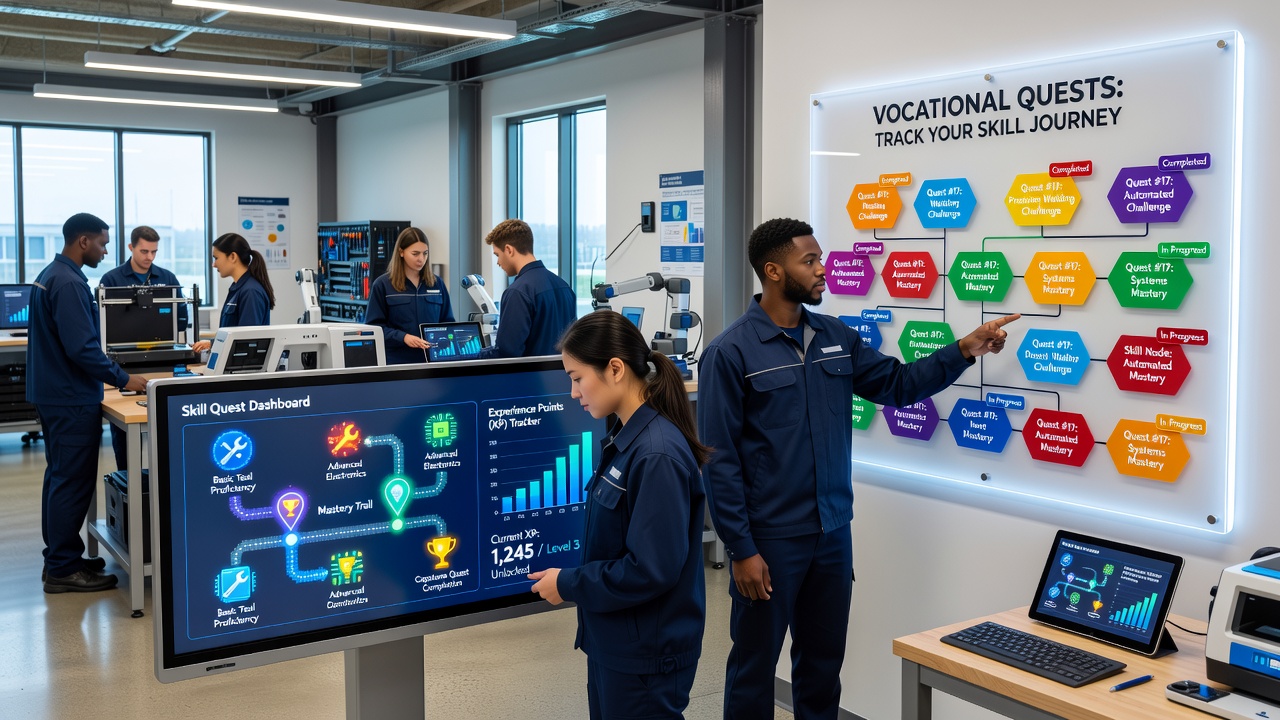
Vocational training programs across multiple regions now incorporate quest elements such as leveled challenges, progress badges, and sequential skill gates to monitor how learners achieve and retain competencies over extended periods. These systems replace traditional checklists with structured pathways where each quest represents a defined skill bundle, and completion data feeds into longitudinal records that institutions review at set intervals.
Core Mechanics Behind Quest Integration
Programs structure quests around specific competencies like welding techniques or network configuration, and learners advance only after demonstrating consistent performance across multiple attempts. Data logs capture not just pass or fail outcomes but also time spent on retries, error patterns, and peer collaboration metrics. Researchers at several European vocational centers report that this layered recording allows instructors to identify mastery plateaus months after initial training ends.
September 2026 marks the scheduled expansion of a multi-site pilot in which Australian and Canadian institutions will share standardized quest data formats, enabling cross-border comparison of skill retention rates. Officials from the Australian Skills Quality Authority note that unified tracking protocols should reduce redundant assessments when workers move between countries.
Longitudinal Tracking Methods in Practice
Instead of end-of-course exams, many programs now require learners to revisit earlier quests at six-month and twelve-month marks to verify skill stability. A dashboard displays decay curves that highlight which abilities fade fastest, prompting targeted refresher quests. One study conducted by the U.S. Department of Labor's Employment and Training Administration found that programs using this revisit cycle recorded a 23 percent improvement in on-the-job skill application compared with cohorts assessed only at graduation.
Regional Program Examples
In Germany, several Berufsschulen have mapped their dual-system apprenticeships onto quest trees that align with chamber certification requirements. Apprentices log each completed task as a quest milestone, and chamber examiners pull the accumulated data during final reviews rather than administering separate practical tests. Similar structures appear in Singapore's Institute of Technical Education, where quest completion rates directly influence eligibility for advanced modules.
Observers at the European Centre for the Development of Vocational Training documented that quest-based records allow training providers to adjust curriculum pacing in real time when aggregate data shows widespread difficulty with particular skill clusters. The same reports indicate that employers receive anonymized cohort summaries that help them anticipate which new hires will need additional onboarding support.
Data Sources and Measurement Standards
Programs collect timestamps for every quest attempt, along with video or sensor evidence where applicable. Standards bodies are currently harmonizing how mastery thresholds are set, so that a "level three" designation in one country carries equivalent meaning elsewhere. Figures released by the U.S. Department of Labor show that standardized quest metadata has already reduced administrative reporting time by an average of 14 hours per learner per year in participating sites.
Conclusion
Vocational training continues to shift toward quest-driven architectures that treat skill mastery as an evolving dataset rather than a one-time achievement. By embedding sequential challenges and periodic rechecks into the training flow, institutions generate continuous evidence of competence that remains accessible long after formal instruction concludes. The scheduled 2026 data-sharing initiatives between Australia and Canada illustrate how these systems scale beyond single programs, creating portable records that follow workers across borders and career stages.